
One in Five: ATP Credentialed Requests Reach Record Share of VRS Network Traffic
Industry data shows more than 20 percent of all Verification Router Service requests carried Authorized Trading Partner credentials from February through June 2026, up from under one percent a year earlier
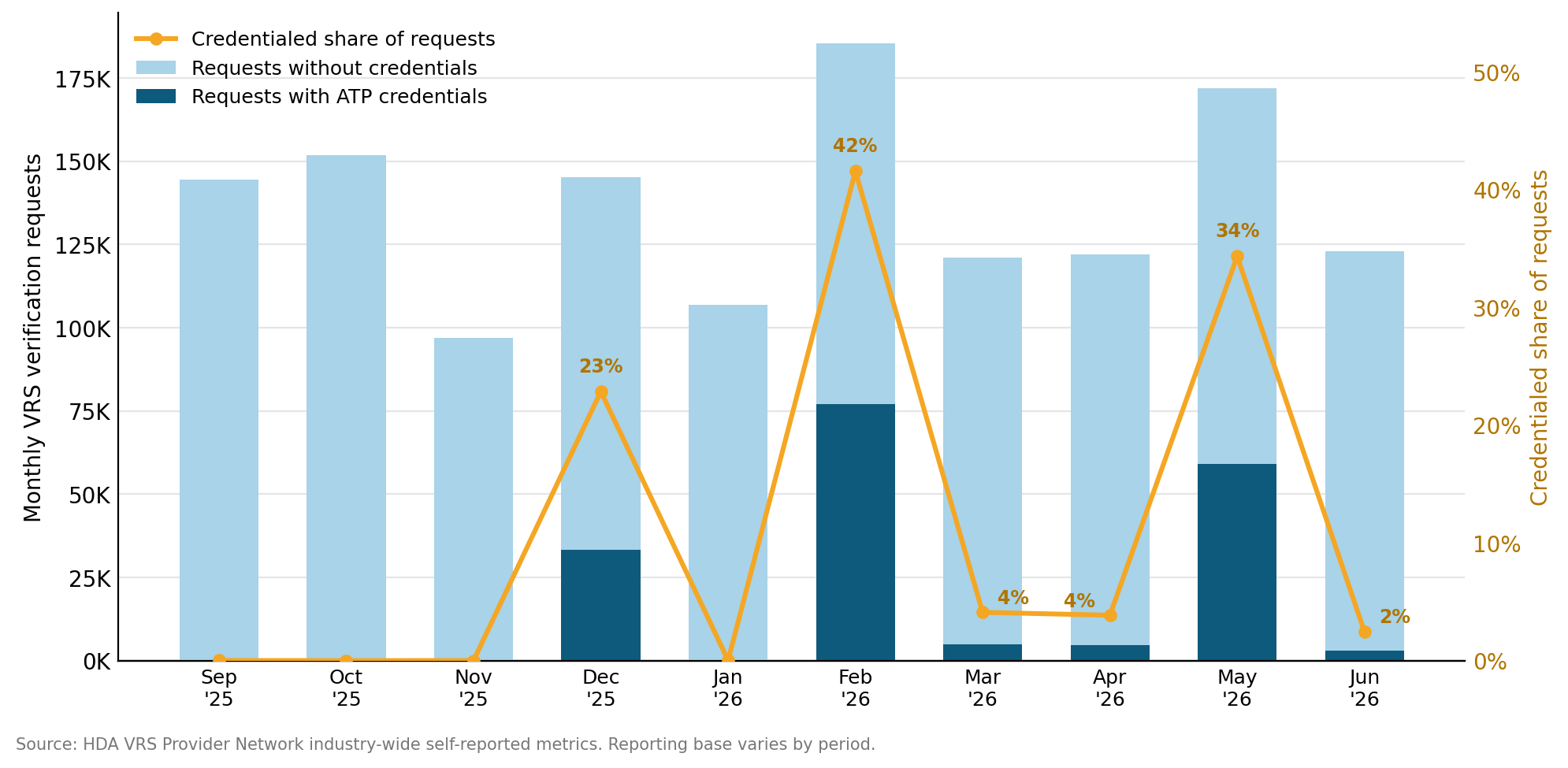
NEWTOWN, PA — August 24, 2026 — The Open Credentialing Initiative (OCI) is pleased to report that Authorized Trading Partner (ATP) credential usage on the Verification Router Service (VRS) network has reached a new milestone. According to industry-wide metrics self-reported by VRS service providers through the Healthcare Distribution Alliance (HDA) VRS Provider Network, 148,742 of the 723,415 verification requests recorded from February through June 2026 carried ATP credentials. That is 20.6 percent of all VRS requests, or roughly one in every five requests.
The VRS is the pharmaceutical industry's shared infrastructure for product identifier verification under the U.S. Drug Supply Chain Security Act (DSCSA). When a wholesale distributor or dispenser needs to verify a product, often before reselling a saleable return as required under DSCSA, the VRS routes that request across the network to the manufacturer's system of record and returns an answer in about a second. Every verification is a moment of trust between trading partners who may never have interacted directly. ATP credentials strengthen that trust by cryptographically proving the requester is an authorized trading partner, replacing manual authorization checks with instant, automated ones and shielding the network from unauthorized actors.
Across most of 2025, credentialed requests accounted for less than one percent of network traffic. The November 2025 through January 2026 reporting period saw the share climb to 9.5 percent, driven by a landmark December in which a large health system went live with fully integrated ATP credentials. The February through June 2026 period has now more than doubled that share, with credentialed volume peaking at over 77,000 requests in February and 59,000 in May.
Sustained Network Growth
ATP credential adoption is compounding on top of a network that is itself growing. Monthly VRS request volume has held above 100,000 in every month since December 2025, averaging roughly 145,000 requests per month from February through June 2026. June 2026 volume was 53 percent higher than June 2025. Sustained six-figure monthly volume signals that VRS is operating as an embedded network function rather than a transitional compliance tool.
Sustained Network Performance
Network performance has kept pace with growth. Average response times across all requests remained in the sub-second range, with June 2026 recording the fastest overall average in the reporting series at 0.70 seconds. Requests carrying credentials averaged around one second in the highest volume months, in line with the network as a whole and consistent with prior findings that ATP checks add security without a material performance penalty.
Evolving Network Usage
Originally designed for wholesalers to verify saleable returns, the VRS has expanded to include other uses for product identifier verification, such as status checks, exceptions reporting & management, and suspect & illegitimate product investigations. Regulators, health systems, and independent pharmacies have become increasingly active, moving from high-volume exercises to operationalizing credentialed VRS requests in their standard operating procedures (SOPs) and routine audit and enforcement workflows.
“Summer 2026 is the milestone the credentialing community has been working toward,” said Alex Colgan, CCO, LedgerDomain. “A year ago, credentialed requests were less than one percent of the network. Today they are one in five, and the infrastructure is handling that shift without breaking a sweat. This is a testament to years of hard work by VRS providers, credential issuers, digital wallet providers, and the trading partners who put these tools into production.”
“Credential adoption may have started slow, but it is now gaining significant momentum as trading partners recognize business benefits that go far beyond mere DSCSA compliance. With ATP checks integrated directly into the VRS workflow, this infrastructure is delivering real operational value,” said Michael Ruether, CEO, Spherity Inc.
OCI extends its gratitude to the participating VRS service providers whose commitment to self-reporting made this data available, and to the HDA VRS Provider Network for convening the industry updates where these findings were first presented. Reporting coverage has expanded alongside the network itself, with the most recent period drawing data from seven of eleven VRS service providers.
As adoption events continue through 2026, OCI remains committed to supporting all stakeholders, from manufacturers and distributors to independent pharmacies, hospital systems, and large chains, in adopting interoperable digital credentials that keep the U.S. drug supply secure.
About OCI
The Open Credentialing Initiative (OCI) is a collaborative non-profit group formed by a cross-section of pharmaceutical supply chain stakeholders. OCI is dedicated to developing and promoting the use of interoperable digital credentials to meet DSCSA requirements and enhance the security of the U.S. drug supply.
For more information and updates on ATP credentialing, visit www.oc-i.org/updates.
⸻
Media Contact:
OCI Communications Team
info@oc-i.org